Category Archives: Eventos académicos

Participation in the 51st AME Conference in Finland

Buxarrais en AME

From August 7th to 9th the 51st Conference of the Association for Moral Education, was held in Tampere, Finland, under the title “Caring About and For Others: Teaching and Learning to Care,” which was organized by the University of Tampere and Texas A&M University.

Dr. Maria Rosa Buxarrais, together with Dr. Ana Novella, Dr. Laia Ferrús, and Dr. Elena Noguera, presented a paper entitled “Intersections between children’s rights and care in participatory childhood experiences: A relational model”.

 
Abstract

This communication examines the vital relationship between adults and children to ensure well-being and foster active citizenship. It emphasizes children’s rights to participate in decisions affecting them and positions them as active agents in society. Drawing on experiences from three projects — Kids Got Rights, IMCITIZEN, and WETAKEPART — it presents a model that connects care and rights across five levels: protection, respectful interaction, information, effective exercise of rights, and collaborative promotion. This model advocates for mutual respect, expanding children’s agency and promoting their role in defending rights. It offers practical guidance for educators and professionals to foster a moral education rooted in human rights“.

EquipoLeft to right: Laura Fontán, Eric Ortega, Maria Rosa Buxarrais, Laia Ferrús y Elena Noguera.

Additionally, Dr. Buxarrais, as President of the Good Work Award Committee, presented this year’s award to Hsin-chang Tsai from National Taiwan Normal University (Taiwan).

Good Work AwardDr. Buxarrais with Hsin-chang Tsai, at the award ceremony

Examination panel at UNED

On July 24th, Dr. Maria Rosa Buxarrais participated in the examination panel for the professorship position of Dr. Ángel de Juanas Oliva, which took place in the Faculty of Education of the National University of Distance Education (UNED). The other members of the examination panel were Dr. José Luis Álvarez (University of Córdoba), Dr. Esther López (UNED), Dr. Ramón Mínguez (University of Murcia) and Dr. José Manuel Suárez (UNED).

Foto de grupoFrom left to right: Ramón Francisco Mínguez (UM), Maria Rosa Buxarrais (UB), Ángel de Juanas (candidate, from UNED), José Manuel Suárez (UNED), José Luis Álvarez (UCO) and Esther López (UNED).

Participation in 13th CIDUI 2025

MRB at the conferenceDr. Maria Rosa Buxarrais participated in the 13th International Conference on University Teaching and Innovation (CIDUI) 2025, entitled “Today’s Teachers for Tomorrow’s University”, which took place from July 9 to 11 at the University of Barcelona.

Dr. Buxarrais, together with Dr. Max Turull, both from the University of Barcelona, presented the paper “L’observació entre parells com a eina per a la millora docent: Un enfocament interdisciplinari a l’educació superior” (“Peer observation as a tool for teaching improvement: An interdisciplinary approach in higher education”).

Abstract

Our research focuses on peer observation as a strategy to improve teaching in higher education, self-assessment and teaching reflection, interdisciplinary interaction, and the formation of learning communities, thereby promoting effective pedagogical practices and continuous improvement in university teaching. The project brought together 27 teachers from different disciplines, with the objective of opening up university classrooms, advocating for collaborative reflection on teaching/em>”.

Participation in SEPCPN 25, Seville

From June 16 to 18, the Spanish Society of Pedagogy (SEP), in collaboration with the University of Seville, its Faculty of Education Sciences, and the LITERACIES research group (HUM1044), organized the 18th National and 11th Ibero-American Conference of Pedagogy (SEPCON25) at the Faculty of Education Sciences of the University of Seville.

Dr. Maria Rosa Buxarrais, along with Dr. Juan Llanes, both from the Faculty of Education of the University of Barcelona, ​​presented a paper at this forum entitled “El “peer review” en la docencia universitario: Un análisis disciplinar de la tarea docente como reto de mejora y calidad” (see abstract below).
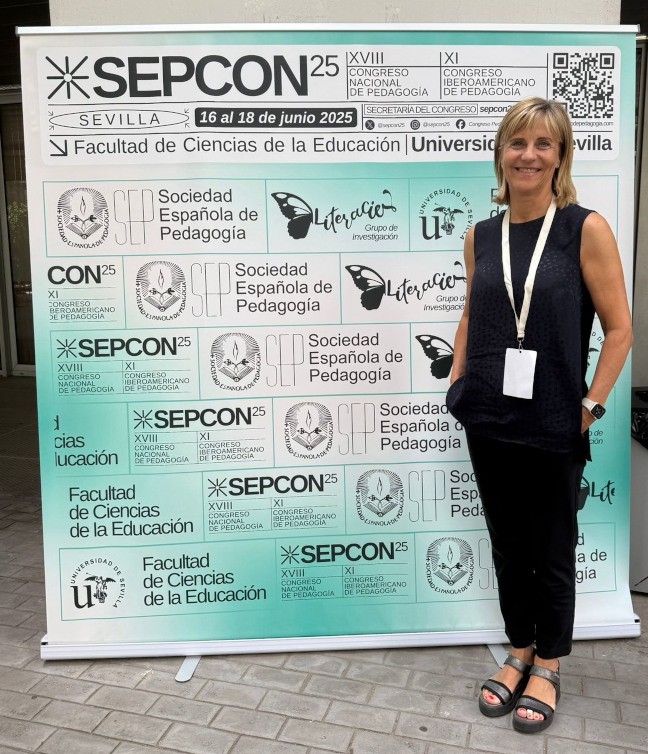
MRB en el congreso

Abstract

The presented research is part of the project “El peer review en docencia: el análisis disciplinar de la tarea docente como reto de mejora y calidad”, led by the University of Barcelona. This project brought together 27 instructors from various disciplines with the aim of opening up university classrooms to peer observation, thereby promoting collaborative reflection on teaching. The main research questions were: How does peer observation influence teaching self-assessment? and What specific contributions does this practice provide to student learning? The theoretical framework is based on literature concerning peer observation (Bell & Cooper, 2013; Hammersley-Fletcher & Orsmond, 2004), self-regulation and pedagogical reflection (Clark, 2012; Fernández & Paricio, 2019), and the importance of breaking with “pedagogical solitude” (Shulman, 1993) to build collaborative teaching communities focused on the continuous improvement of educational practice.

The methodological approach is qualitative, using peer observation as the primary strategy (Bell & Cooper, 2013). An instrument structured around four dimensions was designed: session organization, fostering interest, dialogic interaction, and strategies for self-regulation (Otero-Saborido et al., 2024). This instrument includes express observations (one day in the classroom) and long-term observations, with scheduled visits. The experience, supported by models of reflective feedback (Jones & Gallen, 2016), was carried out in an interdisciplinary context, fostering shared analysis among teachers from different areas. Furthermore, data were collected using evaluation forms and interviews to identify strengths and areas for improvement.

The research results highlight the usefulness of peer review as a tool for continuous improvement in university teaching (Hammersley-Fletcher & Orsmond, 2004). Among the main contributions, a higher level of self-reflection among instructors regarding their pedagogical practices was identified, derived from the structured analysis and subsequent discussions (Clark, 2012; Shulman, 1993). Likewise, the experience promoted interdisciplinary exchange, enriching teaching perspectives through the integration of varied approaches (Fernández & Paricio, 2019).

Furthermore, the use of the developed instrument made it possible to identify key elements in the planning and execution of teaching sessions, as well as effective strategies for fostering student participation and autonomous learning (Otero-Saborido et al., 2024). Finally, it was observed that these practices strengthen cohesion among the teaching staff and generate learning communities oriented toward constant improvement, in line with the proposals of Bell and Cooper (2013)“.

Conclusion of Didaskalia’s Pilot Cycle

Foto grupo

On May 29th, the final session of the pilot program on teaching evaluation took place, coordinated by the Didaskalia Network. This network was established in July of last year and consists of academic and technical staff working in teaching evaluation, quality assurance, and training units at the University of the Basque Country (UPV/EHU), the University of Deusto (UDeusto), and the University of Vic – Central University of Catalonia (UVic-UCC).

The pilot program began in January, with five universities selected out of eleven applicants to receive support in improving their teaching processes: the Open University of Catalonia, the Autonomous University of Barcelona, the Rovira i Virgili University, the Autonomous University of Madrid, and the University of Granada.

Since February, webinars and decentralized supervision sessions have been held to help each university prepare its self-evaluation report on teaching. The overall assessment of the program was very positive, and ideas were proposed regarding its continuation.